Featured

1 Minute Documentary – Christmas Task

Over Christmas, I was tasked to create a 1-minute documentary film. This could be anything we wanted. As I was traveling back home to Poland, I decided to take the opportunity to document an old Polish tradition. Sleigh Rides.

Sleigh rides are a form of entertainment in Poland. They are organized during the last week of the winter carnival. The winter carnival is a period of winter balls, masquerades, marches, and games. During the carnival, there is a lot of music, singing and bonfire fun.

Find attached the documentary video below.

Final Film & Evaluation

After multiple complications due to the COVID-19 virus, and the nation going into lockdown as per government rules, we managed to complete the final product. The video is shown below:

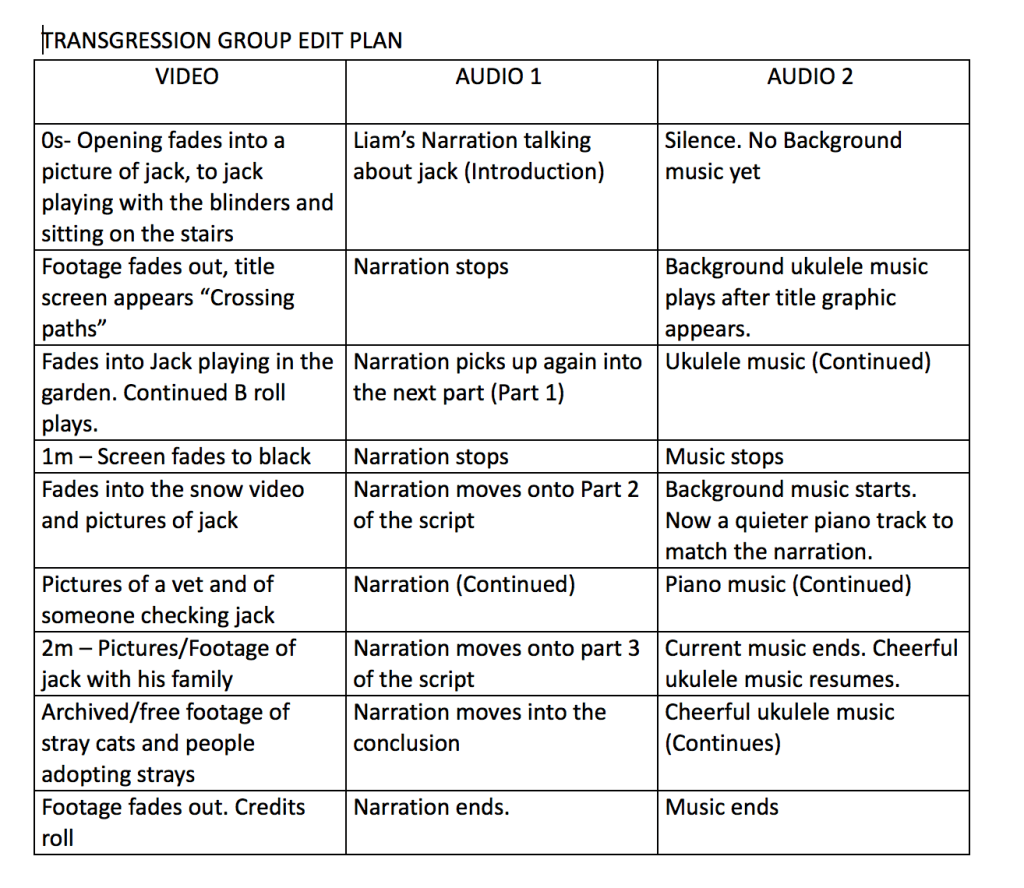
Looking back at what went well, I would say our team coordination and communication was our strongest point. As none of us have ever worked together before, I was pleasantly surprised at how fast we managed to sync with each other and the dedication we put into the project. We met every week on a Tuesday, setting ourselves tasks to do for each week. We started off with brainstorming ideas for the RSPCA project, which was unfortunately not carried out due to the lack of response from the RSPCA Centre in Coventry. We then decided to come up with a new idea, and through a team effort, we came up with the story of a stray black cat, which was owned by Evie, one of the group’s members. When further developing the idea, we decided to plan out a 3-act structure, which I believe worked very well. The 3-act structure ensured a distinct narrative which was easy to understand and wouldn’t bore the audience. We decided on narrating the documentary video and give it a “voice of God” narration. This would ease the audience into the video as well as conform to the expository mode of documentary. We had some really good shots however, I believe that due to the COVID-19 virus we were limited to a range of pre-shot footage which we intended to use as B-roll. We believe we utilised the footage we had to the best of our ability to support the narrative. We used some uplifting ukulele music for the background as we tell the story of Jack. This ensures the audience that stray cats are no different from friendly domestic cats. We also used some sad piano music when we told the story of the conditions Jack was found in. This was used to make the audience feel sympathy for the cat and understand that adopting strays is an alternative option to buying normal pets. The moral of the narrative is that black cats don’t always bring bad luck, even though that is how society views them. Overall, I believe this is the best we could do as a group in order to create the video with the pandemic limiting us to the content we could include. We could have had a better range of shots for the video had the lockdown and self-isolation not been reinforced across the nation. I believe we all put our best efforts into the project.

Narration script

  -Narration Script 

-Part 1 (Introduction)

This is Jack, He was found in Birmingham and now lives with the west family. Some say black cats bring bad luck. But for jack, it was luck that saved him, and from a chance encounter his life was changed forever. (15sr)

-(Title drop: Crossing Paths) 

We don’t know where jack was from. He had no collar, chip and there was never any sign that someone was looking for him. So, when the West’s took him in he slowly became a part of the family. Displaying love, affection and a playful nature to those around him. (18sr)

Jack is a permeant fixture of the family now and has always retained a warm nature since he was a stray, adapting perfectly into a life of a healthy cat. Curious, Sociable, lazy and above all, Happy. But life would have been much different for everyone if not for that fateful day. (18sr)

-First section is 51 seconds long roughly 

-Part 2 (Origins) 

It was on their doorway when they first saw jack, taking shelter from harsh snow and wind. They guessed he was a stray from how malnourished and thin he was. Then once offered food, jack surprised them by how affable he was.(13sr)

He stuck around then after his meal, staying in the garden for months and often coming inside when the other cats warmed up to him. Jack was always ravenous with food and excited when presented with a meal, coming to trust the Wests more and more. (15sr)

They eventually took him to a vet, and found no evidence of any microchip or ownership. Which was surprising considering how friendly and family orientated he was for a stray. The Wests had taken their search for an owner both virtually and physically. Finding no mention of a missing cat of Jacks description. (18sr)

And so, on Christmas Jack was officially apart of the family. By the eve he spent his first night in, sat on the table cuddling the remote and enjoying the warmth of the fire with a loving family. (11sr)

-Second section is 57 seconds roughly. P1 + P2 = 1:48s 

-Part 3 (Present day and lessons learned)

The majority of Europe may consider jack to be a symbol of misfortune and bad luck, however jack defied those superstitions and became a staple of the West family. (10sr)

Jack now lives a comfortable life from being in a bad place, but at the right time. Most stray cats would have been mistrustful of the Wests, and most people are mistrustful of stray cats. But Jack shows us that everyone should be given a chance, and that a bit of kindness can change a cat’s life forever. (18sr) 

Third section is 28sr. Full length of the script is roughly 2:16. Potentially 10s longer if I speak slowly as to not sound like I’m rushing the script. 
Shooting Script

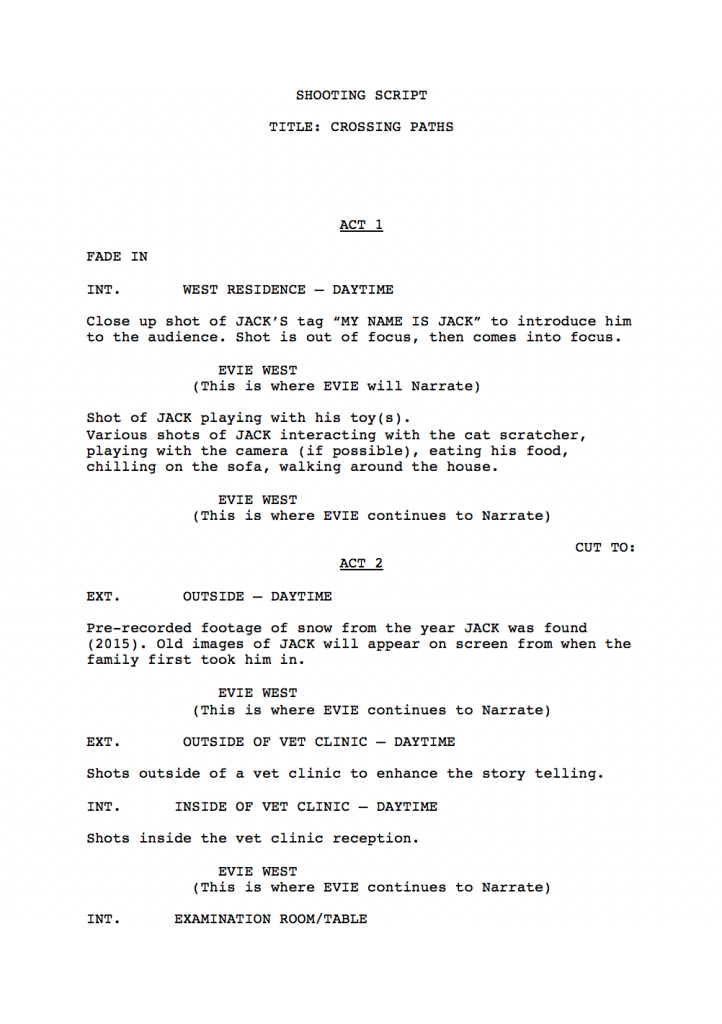
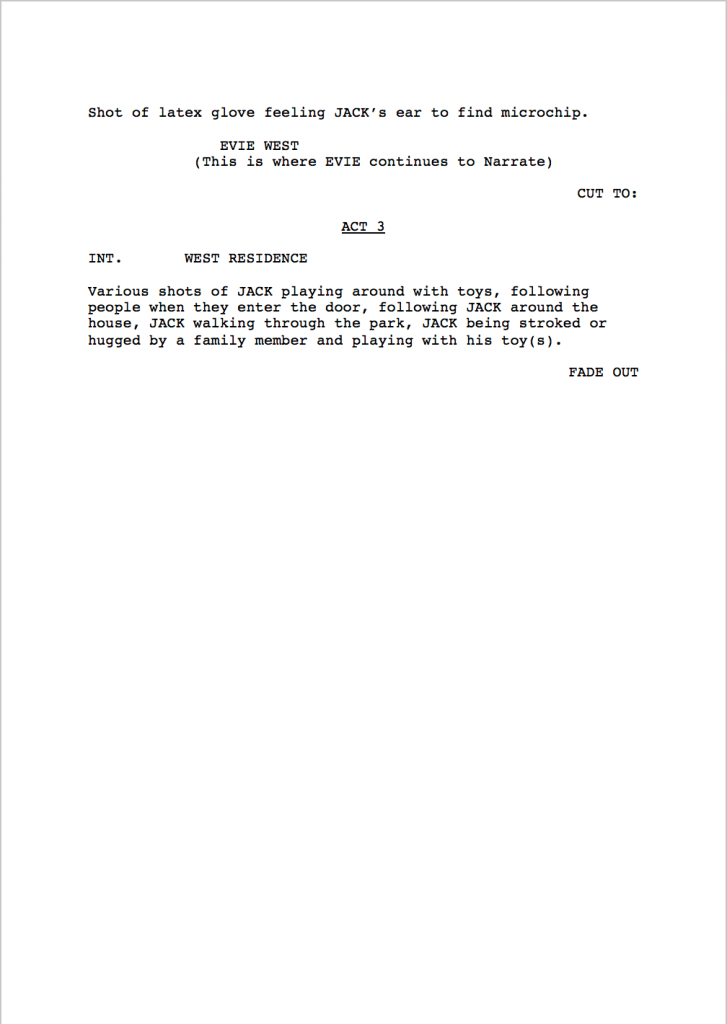
Here is a rough draft of a shooting script we have worked on.

FINAL SHOT LIST

  • Jack interacting with cat scratcher, playing with toy(s), playing with camera, eating his food, chilling on the sofa, walking around the house, interacting with other cats
  • Establishing shot of house
  • Shots in the park
  • Shots outside
  • Shots outside a vet clinic/inside a vet clinic
  • Shots of latex glove touching his ear looking for a microchip
  • Shots of Jack following people around the house, being stroked by a family member.

Treatment

Title: Crossing Paths 

Treatment: 27/2/20 

Part 1 – Introduction  

Beginning is a shot of a cat’s nametag, in which then moves to revealing the subject of the documentary, Jack the adopted cat. Narration of Jack’s owner will immediately start after the first few seconds which establishes his background as a stray cat and how he fits in with the rest of his family. The documentary will periodically switch between narration on Jack’s behaviour and raw footage on him interacting with people and other pets, however the footage should focus more on jack himself. This first section is for the purpose of introducing and fleshing out Jack so that the next scene is more impactful.  

Part 2 – Past and Consequence 

The documentary will shift to past tense, with footage playing of the snowy weather that Jack was recovered from, along with any images and footage of jack in his early days with the family. The Narration will focus on Jack’s nature as a stray, the issues that came with It and how they were overcome. One scene planned would be when he was taken to the vet (with shots in one) after he was found and his road to recovery.  

Part 3 – Present day and lessons learned  

The last part will further explore Jack’s relationship with the family and what the audience can learn from jack. The footage will show Jack exhibit lively and playful behaviour through playing outdoors or inside with the other cat’s and exploring his environment. Throughout this the Narration will describe how finding jack brought the family good luck through a close companion and that only the audience can help improve the condition of stray cats, as there may not be as many stray cats as fortunate as jack.  

Idea Update

After no luck with getting in contact with the RSPCA, Liam, Evie and myself decided to think of plan B.

Our new idea is based on a strayall-black cat called JACK. Jack was a stray found during a snowy winter in 2015 by the West family. He was checked over by the vet and taken in when they found out he didn’t belong to anyone. He quickly became the heart of the family, and is in a loving and caring environment.

We want to create a documentary on Jack’s journey of being a stray and being found by a loving family. We will be exploring topics such as the life of strays, and the hardships they face. We will also be exploring the idea that black cats bring bad luck, and how in this case, Jack’s luck was infact good.

We have decided that we will base our documentary on a 3-act structure; the three acts being :

  1. Introduction of Jack.
  2. Jack’s story of going from stray to loved
  3. How he fits in at home now.

The Observational mode and Expository mode still applies for this idea, as we will still be portraying the truth through documenting a real stray cat, and it’s true story providing the viewer with facts rather than speculation. We will also still be using a voiceover for the story telling as Jack the cat himself can’t speak on all the topics we aim to portray.

Idea Pich

Following my initial idea to involve wildlife within this module, I have decided to base my documentary on the RSPCA and the hardships they face as a charity fighting against animal cruelty. I want to explore their challenges, introduce animal victims who suffered from animal cruelty, and then finish off with the way they plan/are battling this issue.

When writing the treatment, I had to think on the style of documentary I want to record in. Looking back on the different documentary modes we explored in our previous lecture, I have cross-referenced my idea against all the modes, ending up with the Expository mode and Observational mode.

Expository mode – explores specific arguments/points through an authoritative voice. This links to my idea as I will use the RSPCA representative to voice the RSPCA’s arguments/points to explain their mission as a charity fighting animal cruelty.

Observational mode – observes the truth. This links to my idea because I aim to portray real animals who have fallen victim to animal cruelty, and want to provide the viewer with true facts about the charity and how they work.

The rule of Four

In today’s lecture we explored the rule of four.

A documentary must have the following:

  • Strong story – classic 3 act structure but not necessarily in that order
  • Strong character – screen presence is a quality that has to be nurtured
  • Strong imagery – visuals and audio liberated but in unison
  • Strong journey – a challenge, obstacle or struggle to be overcome

Having an understanding of this is important in order to create an impactful documentary.

Documentary Modes

In today’s lecture we explored different styles of documentary. This is essential for me to have an understanding of when planning my own documentary for this module, and any future documentaries I work on in the future.

Nichol’s 6 Modes of Documentary

Poetic Documentary

Instead of using traditional linear continuity to create a story structure, the poetic documentary filmmaker arrives at its point by arranging footage in an order to evoke an audience association through tone, rhythm, or spacial juxtaposition.

Expository Documentary

Appearing in the 1920’s, this mode constructs a specific argument or a point of view for the audience. Generally, the formula is a resonating, authoritative voice that tells you something with corresponding footage providing that it is, indeed, true.

Observational Documentary

The filmmaker observes the truth by letting the camera capture it’s subjects uninterrupted.

Participatory Documentary

This documentary mode invites the subjects to participate with the filmmaker – usually being interviewed.

Reflexive Documentary

Not about the relationship with the filmmaker and the subject, but rather the filmmaker and the audience.

Performative Documentary

This documentary mode emphasizes truth as relative, favouring a personal take over the objective lens.

Create your own website, free on WordPress.com.Create your own website.
Start free